AI Won't Kill Software Jobs. It Will Kill the Bullshit Around Them

Every week, tech leaders claim AI will end software development. But look past the sales pitch. AI isn't destroying engineering—it's exposing the padding, burning away the bloat, and returning leverage to the client.
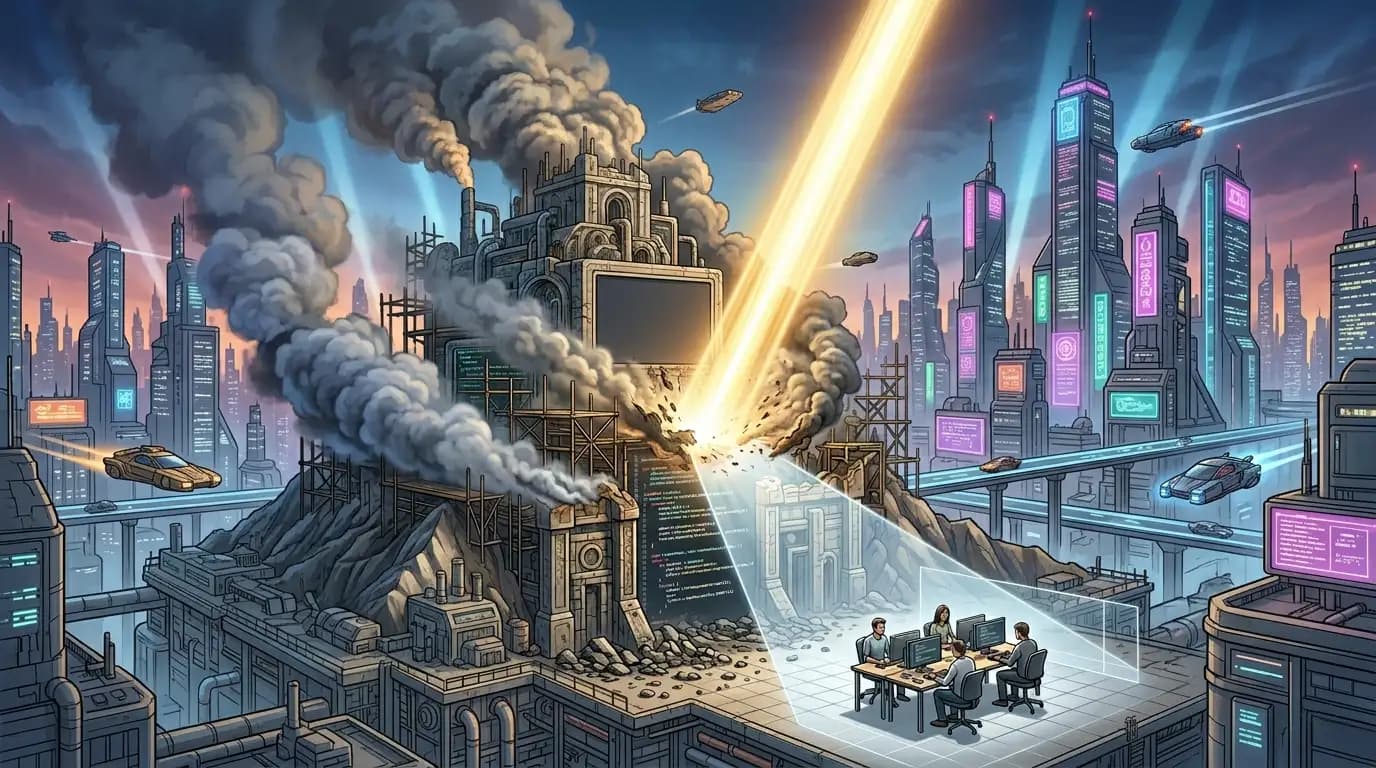
Every few weeks, Sam Altman or Dario Amodei steps onto a stage and tells the world that software developers are going extinct. That AI will replace most jobs. That we're standing at the edge of a cliff.
Let's be honest about what that actually is. It’s partly a genuine belief, and partly a very effective sales pitch.
When the CEO of OpenAI tells you Codex will replace engineers, he also needs you to be scared enough to buy Codex. When the head of Anthropic says AI will automate most cognitive work, he also needs CTOs anxious enough to sign enterprise contracts for Claude. Fear is an extraordinarily effective marketing tool. And these are extraordinarily good marketers.
But here's a more useful question - have we been here before?
The platforms didn't kill the space, they killed the low-value work
When Shopify and Magento arrived, the consensus was that ecommerce developers were finished. Why would anyone pay an agency to build a store when a platform could do it for a fraction of the cost? The ecommerce development industry grew. The platforms didn't kill the space, they killed the low-value work, raised the floor of what clients expected, and created entirely new categories of specialisation that didn't exist before.
AI will do the same thing. Just faster, and across a much wider surface area.
What AI is actually doing is exposing the enormous padding that the software industry has gotten away with for decades. The reason a custom project used to cost a million dollars wasn't entirely because it was worth a million dollars. A significant chunk of that were long timelines, bloated teams, jargon-heavy proposals designed to keep clients at arm's length from understanding what was actually being built.
Clients were never too dumb to understand software. They were kept deliberately confused.
AI is burning that fog away. What used to take six months can take six weeks. What required a team of twelve might need a team of four. Not because the work disappeared, but because the inflation is harder to justify.
That's not job destruction. That's a long overdue correction.
The disruption is real. Nobody serious is arguing otherwise. What's manufactured is the apocalypse framing. Because that framing serves a very specific purpose, it makes AI feel inevitable and omnipotent, which makes you more likely to adopt it immediately and at scale.
What will actually change is how services are rendered, how software is priced, and how much leverage clients finally have in conversations they were previously locked out of. The developers who were solving genuinely hard problems with architecture, edge cases, data integrity, systems that actually hold up under real-world pressure aren't going anywhere.
What's going away is the ability to charge enterprise rates for work that is fundamentally mechanical. And the ability to hide that it was mechanical all along.
That's not the end of software development. That's the end of getting away with it.

About Indranil Gupta
Indranil sits at the intersection of product vision and technical architecture. He oversees the lifecycle of our most complex systems, specializing in reactive microservices and distributed databases. His dual focus ensures that our ambitious product designs are backed by robust, high-availability infrastructure capable of scaling effortlessly.