The Rise of Valleynese (or, "Why Everyone is Starting to Sound Like a Tech Bro")

AI is the largest force ever applied to homogenising the register in which the human race writes. Bigger than Hollywood, which only gave us 'cool' and 'OK.' Bigger than global pop, which only gave us 'vibe' and 'lit.' Neither ever drafted anyone's emails or rephrased the message a daughter was sending her father. AI does all of this, all day, for hundreds of millions of people.
A few weeks ago, an AI assistant told me that one of my decisions was "belt and suspenders." I knew, vaguely, that this was meant to be positive but I had no idea why my decision was now wearing two separate means of holding up its trousers. It was not the first time that an AI agent had spoken to me in a dialect I half-recognised and could not quite place. Somewhere between that phrase and the next one, I realised I was no longer getting advice. I was conducting a small, polite ethnography of where the AI had come from.
It had come from Silicon Valley. Specifically, from the keyboards of about two million engineers, founders, venture capitalists, and Hacker News commenters whose collective output makes up an outsized portion of the text that taught large language models how to write. The dialect itself is older than the AI; it grew up in startup garages over two decades, was polished in the essays of a handful of influential founders, and travelled the world through GitHub readmes, conference keynotes, and the LinkedIn posts of people who use the word "thesis" a great deal. By the time the AI began to read the internet, this dialect was already the lingua franca of the most fluent third of it. AI did not invent it; it inherited it. Now, every time I ask it for help, it brings the dialect with it; like a perfectly competent assistant who has somehow, alarmingly, learned to talk only at YC demo day.
I have a name for this dialect: I call it "Valleynese." And it peppers every sentence AI utters. Decisions have "blast radius." Mistakes are "footguns." Plans get "shipped." People get "looped in." Ideas are "ergonomic." Companies have "moats." Everything "compounds." Things are "spun up" rather than started, "asymptote toward" rather than approach, and arrive at "table stakes" rather than the bare minimum. A surprising number of perfectly ordinary verbs have been quietly replaced by industrial processes.
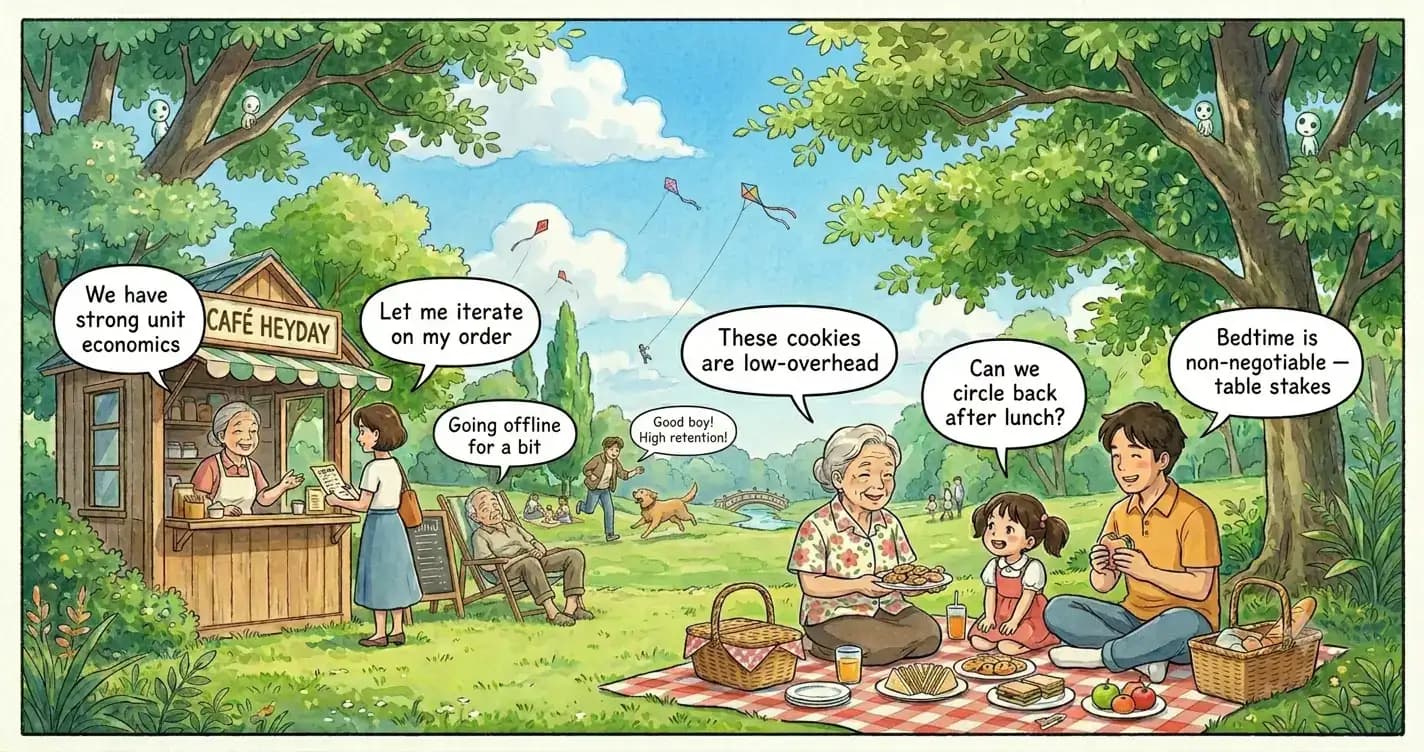
I asked the same AI to recommend a holiday destination in this neck of the woods and it said that Sri Lanka had "strong product-market fit for relaxation." I asked for a recipe, and it suggested I "iterate on the seasoning." I asked it to write a toast for a colleague's birthday, and it suggested his life so far had been "high-conviction" and his future looked "asymmetric." I think I am one of the lucky ones; somewhere in the world a grandmother is being informed that her chocolate chip cookies are "low-overhead."
This is amusing until you realise what is actually happening. AI is the largest force ever applied to homogenising the register in which the human race writes. Bigger than Hollywood, which only gave us "cool" and "OK." Bigger than global pop, which only gave us "vibe" and "lit." However, neither Hollywood nor pop music ever drafted anyone's emails, wrote anyone's wedding speech, or rephrased the message a daughter was sending her father. AI does all of this, all day, for hundreds of millions of people. The shopkeeper in Pune, the doctor in Lagos, the lawyer in Manchester; all of us, increasingly, drafting in the same flat, optimistic, engineering-inflected English. The accents of writing are being quietly sanded smooth, and the texture is being replaced by a sort of cheerful efficiency that smells faintly of free office snacks.
I should say, in fairness, that some of it is genuinely useful. English had no single word for a feature that makes it easy to harm yourself, and "footgun" works wonderfully. "Blast radius" captures something about modern decisions that older language did not quite reach. Clearly, the dialect is not a problem. The problem is when it becomes the only dialect. When I read anything online, I notice traces of the dialect underneath. Like a faint accent you cannot place until someone names it for you, after which you cannot stop hearing it.
I will not pretend I am immune. Last week I described my morning walk as "high-throughput" and felt, just briefly, like I had become a slightly different person before lunch. Somewhere, my mother is shaking her head. She still calls it a "stroll."

About Jeetendra Chandragiri
Jeetendra is the driving force behind our forward-looking technological initiatives. He continuously audits emerging paradigms and crafts ambitious roadmaps that keep our clients ahead of the curve. Combining deep strategic foresight with hands-on architectural expertise, he charts the course for our bleeding-edge capabilities and operational innovation.